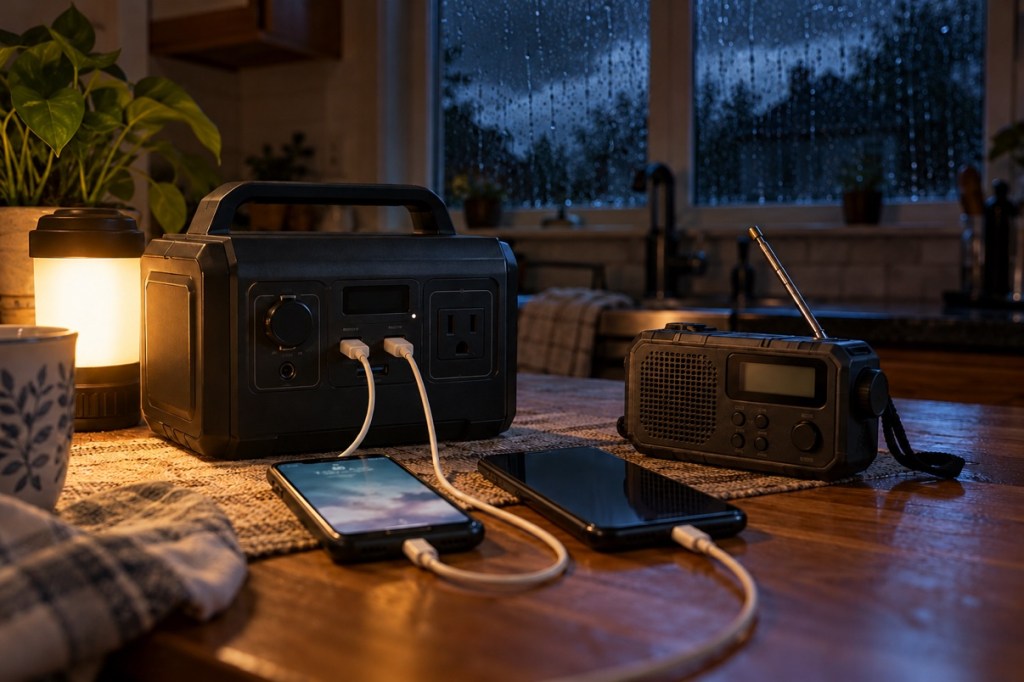
When the power goes out, your phone is your lifeline — weather alerts, family check-ins, outage maps, and a flashlight in a pinch. The good news: phones are tiny loads. Keeping them charged for days takes far less battery than most people expect.
The math
A phone battery holds roughly 15 Wh. Allowing for charging losses, one full charge costs about 18–20 Wh from a power station. A tablet costs roughly 35 Wh, and a laptop 60–100 Wh. So even a small 250 Wh station delivers around ten full phone charges — enough for a household’s phones for several days if you are sensible (airplane mode overnight, charge before the storm, top up rather than full cycles).
Small stations that fit the job
BLUETTI EB3A (268 Wh) — the smallest station we track, with fast charging of its own. Availability is limited since BLUETTI wound the model down, so check the listing before counting on it.
EcoFlow RIVER 3 (245 Wh) — compact and light, built for exactly this layer of backup. We do not currently have a verified shopping offer for it; see the full analysis on its product page.
Jackery Explorer 500 (518 Wh) — the step up if phones share the station with a router and lights. Also analysis-only for now — Jackery no longer sells it new.
Do not overlook the simplest layer: a plain 10,000–20,000 mAh USB power bank, charged before the storm, covers one phone for 2–4 full charges and costs very little. A station earns its place when phones are joined by a router, lights, or a laptop — that is what the sizing guide‘s router preset is for.
We may earn a commission if you purchase through links on this page, at no extra cost to you.

