Author: casey jenkins

  • Portable power station vs. gas generator

    This is the comparison buyers actually need — and we refuse to declare a winner up front. Stations and generators solve different problems, and the right answer depends on two variables: how long your outages last, and how big your loads are. All station specs are Manufacturer specification and all station prices are Price checked 2026-10-15.

    Our picks for this guide

    EcoFlow DELTA Pro 3 — The closest a single portable unit gets to generator territory: 4,000W, 120/240V.

    Jackery Explorer 3000 Pro — 3,000W of output in a 64 lb wheeled unit (refurbished listing).

    We may earn a commission if you purchase through links on this page, at no extra cost to you.

    Runtime economics: fuel cost per kWh vs. battery cycle cost

    The generator side — fuel per kWh. A representative 2,000 W-class inverter generator (1.05-gallon tank, 11.5 hours at 25% load ≈ 4.9 kWh) burns roughly 0.21 gallons per kWh. Estimate: at $3.50/gallon, fuel alone costs about $0.75 per kWh.

    The station side — cycle cost per kWh. The EcoFlow DELTA 3: 1,024 Wh rated, 4,000 cycles to 80%+, $629. Estimate: ~870 Wh usable per cycle × 4,000 cycles ≈ 3.48 MWh lifetime. $629 ÷ 3,480 kWh ≈ $0.18 per kWh.

    What the math says: the battery’s energy costs roughly a quarter of the generator’s fuel energy per kWh. What it doesn’t say: the generator keeps making kWh as long as you have gasoline, while the station stops when the battery is empty. Fuel is expensive energy that never runs out mid-outage (if you stocked it); battery cycles are cheap energy with a fixed tank.

    Where generators win

    • Multi-day outages. A generator refuels in minutes and runs indefinitely.
    • High-wattage loads. Well pumps, electric water heaters, central AC, and 240 V equipment sit far above what portable stations deliver.
    • $/kWh of capacity. Generators deliver far more watts per dollar upfront.

    Where stations win

    • Indoor use. No exhaust, no carbon monoxide. For apartments, this isn’t an advantage; it’s the entire ballgame (see our apartment backup guide).
    • Noise. A station’s only sound is cooling fans under heavy load.
    • Maintenance and readiness. No oil, no fuel to go stale, no pull-cord. Charge it, store it, and it’s ready.
    • Instant-on and electronics. No warm-up, no voltage sag, pure sine wave output.

    The crossover question: outage length × load size

    Small loads (phones, router, lights, laptop)Large loads (fridge, sump pump, well pump, heat)
    Short outage (hours)Station — cheap, silent, instantStation if within its surge rating; otherwise generator
    Long outage (days)Station + solar recharge, or generatorGenerator — no contest on runtime

    The gray zone is the middle: a 2–3 day outage with medium loads. Our outage kit guide works through that middle ground load by load.

    Two concrete station examples from our records:

    • Short outages, small loads: EcoFlow DELTA 3 — 1,024 Wh, 1,800 W continuous, 3,600 W surge, 27.6 lb, $629 (check price).
    • Bigger loads, longer bridge: EcoFlow DELTA Pro 3 — 4,096 Wh, 4,000 W continuous, 8,000 W surge, 113.5 lb, $2,799 (check price .

    Safety, both ways — brief and sourced

    Generators: carbon monoxide. The CPSC reports an average of about 100 U.S. deaths per year from CO poisoning tied to portable generators. Guidance: never run one inside a home, garage, basement, or shed, and keep it at least 20 feet from the house with exhaust pointed away. CO is colorless and odorless.

    Stations: battery fire. Lithium batteries can fail. The confirmed case in this category: the CPSC’s August 2024 recall of HALO 1000 portable power stations (imported by ZAGG) for fire and burn hazards, with one death reported.

    The bottom line: the generator’s hazard is intrinsic to how it works (combustion makes exhaust, always); the station’s hazard is a malfunction mode (a healthy battery doesn’t emit anything). Neither should be used for fear marketing — including by us.

    No single winner — run your numbers

    A station is cheap energy in a fixed tank with no exhaust. A generator is expensive energy in a refillable tank that must live outdoors. The calculator is the next step: enter your devices and outage length, and it shows which record-backed stations cover your loads. Full spec sources for every station named here are on their product record pages.


    One sizing lesson, one verified deal, one maintenance reminder — every week. Join the Outage Brief newsletter.
  • Router, phones, and lights: a 24-hour outage plan

    Not every outage plan needs to power the refrigerator. For most short outages, the difference between misery and comfort is smaller: keep the Wi-Fi on, keep the phones charged, keep the lights on, and top up the laptop.

    This is the cheapest useful backup setup. The entire plan fits in a ~500Wh portable power station — and for apartment dwellers and skeptics, it’s the best first purchase in backup power.

    All runtime figures below are Estimates with assumptions shown. Nothing here is a guaranteed runtime.

    Our picks for this guide

    Jackery Explorer 500 — The smallest unit that still covers a router for a full day (28–31 hours in our model), at $299.

    EcoFlow DELTA 3 — 55–61 hours of router runtime, with headroom for phones and lights too.

    We may earn a commission if you purchase through links on this page, at no extra cost to you.

    The loads

    LoadDraw (typical)Hours in the plan
    Wi-Fi router10–12W24 (running continuously)
    2 phones, full charges~40Wh totalcharged as needed
    3 LED bulbs~27W total3 (evening hours)
    Laptop, one full top-up~65Whonce during the day

    The worked math

    Assume 85% inverter efficiency: divide each load’s energy by 0.85 to get the station capacity it consumes.

    LoadEnergy neededStation capacity consumed (Estimate)
    Router: 10W × 24h240Wh282Wh
    2 phone charges40Wh47Wh
    3 LED bulbs: 27W × 3h81Wh95Wh
    Laptop top-up65Wh76Wh
    Total~500Wh

    A 518Wh station covers this full 24-hour plan with roughly 18Wh to spare (Estimate) — it fits, but the margin is thin.

    Why this is the best first purchase

    • It’s cheap. The ~500Wh class starts around $300 (price checked 2026-10-15).
    • It’s apartment-friendly. No fuel, no fumes, no noise — nothing your lease forbids.
    • It solves the outage you’ll actually have. Most outages are hours, not days.
    • It teaches you the math. Once you’ve run this kit through one real outage, sizing a fridge-scale station later is easy.

    What it won’t run — and why

    • A refrigerator. A 150W fridge would drain a 518Wh station in about 7 hours (Estimate), consuming the entire kit.
    • A microwave. ~1,000W+ draw exceeds the 500W continuous output of this class.
    • A space heater. ~1,500W typical draw — no portable station in this price class runs one.

    Those jobs belong to the 1,000Wh+ tiers.

    Which ~500Wh station, ranked for this scenario

    1. Jackery Explorer 500 — 518Wh, 500W continuous / 1,000W peak, 13.3 lbs. The only unit in our records in this exact class. Tradeoffs: older NMC chemistry (500 cycles to 80%), ~7.5-hour wall recharge, one AC outlet, no USB-C. Around $299 on Amazon (recheck before buying). Check price
    2. BLUETTI AC180 — 1,152Wh, 1,800W continuous, LiFePO4 (3,500+ cycles), 4× AC outlets, 5-year warranty. Roughly double the runtime — run the full plan for 24 hours and still have half the battery left. $499.00 (checked 2026-10-15). Check price
    3. EcoFlow RIVER 3 — 245Wh, 300W continuous, LiFePO4 (3,000 cycles), 7.8 lbs, sub-20ms UPS mode. Covers about half the scenario — router all day plus phones. Direct price could not be verified today. Check price

    Your next step

    Run your exact loads through the Outage Brief calculator with the essentials preset.

    And for one short weekly email with price checks and more outage plans, join the Outage Brief newsletter.

  • LiFePO4 batteries in plain English

    Open almost any portable power station box today and you’ll see the same term on the label: LiFePO4. Pronounced “lithium iron phosphate” (or just called LFP), it’s the battery chemistry inside nearly every current power station. It replaced older lithium chemistries for one reason buyers can actually feel: the battery lasts dramatically longer.

    What it is, in one paragraph. LiFePO4 is short for lithium iron phosphate: the materials used for the cathode of the battery cell. Instead of nickel, manganese, and cobalt — the metals in the older NMC lithium-ion cells — LFP cells use iron and phosphate. That swap gives up some energy density and gains two things that matter for backup power: far more charge–discharge cycles before the battery wears out, and a more thermally stable cell.

    Our picks for this guide

    Jackery Explorer 1000 v2 — Our all-rounder: LiFePO4, 1,024Wh, and the unit we point most readers to first.

    Anker SOLIX C1000 Gen 2 — LiFePO4 with 2,000W output in the same 1kWh class.

    We may earn a commission if you purchase through links on this page, at no extra cost to you.

    What “3,000–6,000 cycles to 80%” actually means

    The most-quoted number on a power station spec sheet is its cycle-life claim. Every figure below is a Manufacturer specification (checked 2026-10-15 in our product records). We have not lab-tested any of these; these are the manufacturers’ published claims.

    ModelCycle-life claim
    BLUETTI Elite 200 V26,000+ cycles to 80%
    Jackery HomePower 1000 Plus v26,000 cycles (to 70%, per launch PR)
    EcoFlow DELTA Pro3,500 to 80% (6,500 to 50%)
    Anker SOLIX C1000 Gen 24,000 cycles to at least 80%
    EcoFlow DELTA 34,000 cycles to 80%+
    EcoFlow DELTA Pro 34,000 cycles to 80% (tested at 0.5C/0.5C, 25°C)
    BLUETTI AC1803,500+ cycles
    BLUETTI AC200L3,000+ cycles to 80%
    EcoFlow DELTA 23,000 cycles to 80%+
    Anker SOLIX F20003,000 cycles
    Anker SOLIX F38003,000+ cycles
    EcoFlow RIVER 33,000 cycles to 80%
    BLUETTI EB3A2,500+ cycles to 80%
    Jackery Explorer 3000 Pro2,000 cycles to 70%+ (lithium-ion, not LFP)
    Jackery Explorer 500500 cycles to 80%+ (NMC)
    EcoFlow DELTA 3 MaxUnverified (no cycle count published)

    “To 80%” does not mean the battery dies. It means that after the stated number of full charge–discharge cycles, the manufacturer rates the battery as still holding at least 80% of its original capacity.

    Estimate, assumptions shown:

    • Daily cycling. 3,000 cycles ÷ 365 days = about 8.2 years before the battery reaches its rated 80% threshold. A 6,000-cycle unit runs to roughly 16.4 years of daily full cycles.
    • Outage-only use. Assume a full discharge about once a month (12 cycles/year): 3,000 ÷ 12 = 250 years. For pure backup duty, cycle life is almost never the limiting factor.
    • The NMC contrast. The Jackery Explorer 500 uses older NMC cells rated for 500 cycles to 80%+. At one cycle per day, that’s about 1.4 years to the 80% mark — roughly one-sixth the daily-cycling life of a 3,000-cycle LFP pack.

    Three honest caveats: these are manufacturer claims measured under controlled lab conditions; batteries also degrade by calendar time; and a cycle-life claim is not a warranty term.

    Safety profile: “safer” does not mean “can’t fail”

    LiFePO4 cells are more thermally stable than older NMC cells: thermal runaway starts at a higher temperature. But a more stable cell is not a failure-proof product — batteries fail at the system level. The confirmed case in this category: the CPSC’s August 2024 recall of HALO 1000 portable power stations (imported by ZAGG) for fire and burn hazards, with one death reported.

    The takeaway: treat LFP as one layer of a safety picture — along with the manufacturer’s battery management design and any third-party safety certification evidence — not as a guarantee. For how to read certification claims, see What UL 2743 does — and does not — mean.

    The weight trade-off you’ll feel

    LFP’s long cycle life costs energy density: LFP cells carry less energy per pound than NMC cells. Rough whole-product figures from our records (Manufacturer specification, checked 2026-10-15):

    ModelChemistryCapacityWeight
    Jackery Explorer 500NMC (lithium-ion)518 Wh13.3 lb
    EcoFlow DELTA 2LiFePO41,024 Wh27 lb
    Jackery Explorer 1000 v2LiFePO41,070 Wh23.8 lb
    BLUETTI AC180LiFePO41,152 Wh35.3 lb
    EcoFlow DELTA ProLiFePO43,600 Wh~99 lb

    For a station that lives in a garage and comes out for outages, the trade (a few pounds for thousands of extra cycles) is one most buyers should take.

    How to spot chemistry on a spec sheet

    Look for “LiFePO4”, “LFP”, or “lithium iron phosphate.” That’s the whole trick for current models: 17 of the 20 units in our product records state LFP explicitly.

    • “Lithium-ion” with no LFP mention is a flag, not an answer. The Jackery Explorer 3000 Pro lists “Lithium-ion” — not LFP — with 2,000 cycles to 70%+.
    • Explicit NMC is the previous generation. The Jackery Explorer 500: NMC cells, 500 cycles to 80%+.
    • Not stated at all. Our records mark it “unverified” — we don’t infer it.

    One decision rule: buy the cycle-life claim you can read, in the chemistry you can verify.


    Next step: run your loads through the Outage Brief calculator — enter your fridge, lights, and phones, and it shows estimated runtimes with the assumptions visible.

    Stay current: the Outage Brief newsletter sends verified price checks, recall alerts, and one new guide a week.

  • One-day, two-day, and three-day outage kits

    This is a shopping list, not a roundup. We define each kit by the loads it has to carry, do the capacity math, then match products from our records to the math. Every spec below is Manufacturer specification and every price is Price checked 2026-10-15.

    How we rank products in this guide: fit for the kit’s load budget comes first, then recharge options for multi-day kits, then weight, then price. Rankings are based on fit and evidence, never commission.

    Our picks for this guide

    Jackery Explorer 2000 v2 — Covers the 12-hour essentials kit at 13–14 hours and scales to longer outages.

    BLUETTI Elite 200 V2 — Same 13–15 hour essentials coverage, best value per kWh in the group.

    We may earn a commission if you purchase through links on this page, at no extra cost to you.

    The three kits, defined by loads

    KitLoads coveredWhat a day looks like
    1-day kitRouter, phones, LED lights, one laptop top-upStay connected and lit for 24 hours
    2-day kitEverything above + full-size refrigeratorKeep food safe and stay connected for ~2 days
    3-day kitEverything above + short cooking sessions + marginRide out a long outage with a real margin

    1-day kit: essentials + phones

    The load budget. Router 288 Wh + phones 30 Wh + lights 120 Wh + laptop 60 Wh = ~498 Wh. At ~85% inverter efficiency, call it ~590 Wh of rated capacity needed — roughly 500–600 Wh.

    Which products fit. The honest fit is the Jackery Explorer 500: 518 Wh, 500 W continuous, 13.3 lb, $299 street (check price). Trade-offs: older NMC cells rated for 500 cycles to 80%, and ~7.5-hour wall recharge. The smaller alternative is the BLUETTI EB3A: 268 Wh, 600 W continuous, 10.1 lb, $219 (check price).

    Non-battery essentials (1-day). A car charger for the station, two LED lanterns, cash in small bills, and a cooler with ice discipline — freeze water bottles before the outage so the fridge stays closed.

    2-day kit: + the refrigerator

    The load budget. A 150 W fridge at 35% duty cycle: 150 × 0.35 × 24 = 1,260 Wh per day — before efficiency losses. At ~85% efficiency that’s ~1,480 Wh of rated capacity for one full day of fridge alone. Add the 1-day essentials (~500 Wh): roughly 2,000 Wh for about one full day of fridge plus essentials (Estimate).

    Which products fit. For multi-day kits, recharge input matters as much as capacity:

    1. BLUETTI AC200L — 2,048 Wh, 2,400 W continuous, 1,200 W solar input (the highest solar ceiling in our records), 62.4 lb, $899 (check price).
    2. EcoFlow DELTA 2 Max — 2,048 Wh, 2,400 W continuous, 4,800 W surge, 1,000 W solar input, 50 lb, $1,049, expandable to 6,144 Wh (check price ).

    Non-battery essentials (2-day). A thermometer for the fridge, ice or frozen water jugs to pre-chill a cooler, paper plates and disposable utensils, and a written plan for the fridge: open it on a schedule, not on impulse.

    3-day kit: + cooking + margin

    The load budget. Fridge 1,260 Wh + essentials 500 Wh + kettle/microwave bursts 300 Wh + 20% reserve ≈ ~2,470 Wh per day. For three days without recharge: ~7,400 Wh — whole-home battery territory. A realistic 3-day portable kit means 3–4 kWh of station plus a recharge plan.

    Which products fit.

    1. EcoFlow DELTA Pro — 3,600 Wh, 3,600 W continuous, 7,200 W surge, 1,600 W solar input, 99 lb, $1,799 (check price).
    2. Anker SOLIX F3800 — 3,840 Wh, 6,000 W continuous, 9,000 W surge, 2,400 W solar input, 132.3 lb, $2,199.99 (check price).

    A third path: the DELTA 2 Max expands to 6,144 Wh with two extra batteries.

    Non-battery essentials (3-day). A camp stove with fuel, 5+ gallons of drinking water, prescription medications, a battery or hand-crank radio, and extension cords rated for the loads.

    Recharge planning between outage days

    • Wall power, when it flickers back: fast units recharge at 1,200–1,800 W AC — a 2 kWh station refills in about 1–2 hours.
    • Solar: a 400 W panel in decent sun delivers ~1,500 Wh per day (Estimate). Check the station’s solar input ceiling in our records before buying panels.
    • Car: a standard 12 V car port feeds ~100 W — roughly 10 hours to add 1 kWh.

    Build it in order

    Buy the kit you can afford now and grow it: non-battery essentials first, then the station that fits your longest realistic outage, then the recharge path. Price moves are tracked on our deal board — buy when the price is genuinely down. Run your own loads through the calculator before you buy anything.


    One sizing lesson, one verified deal, one maintenance reminder — every week. Join the Outage Brief newsletter.

  • Sump pump surge: what the watt rating misses

    Most people who buy the wrong power station for a sump pump made the same mistake: they read the continuous watt rating, matched it to the pump’s sticker, and never noticed the second number that actually decides whether the pump starts. For motors, that second number — surge, peak, or starting watts — is the whole question.

    This guide explains the two tests a station has to pass for a sump pump, shows how to read surge ratings honestly (including the “boost mode” fine print), and works through real products so you can check the math yourself. All specs below are Manufacturer specification, and every price is Price checked 2026-10-15.

    Our picks for this guide

    EcoFlow DELTA Pro 3 — The most surge headroom here (8,000W), and 4+ hours of hard storm runtime in our model.

    BLUETTI Elite 200 V2 — Covers the 2-hour storm window with 3,900W of surge, at $899.

    We may earn a commission if you purchase through links on this page, at no extra cost to you.

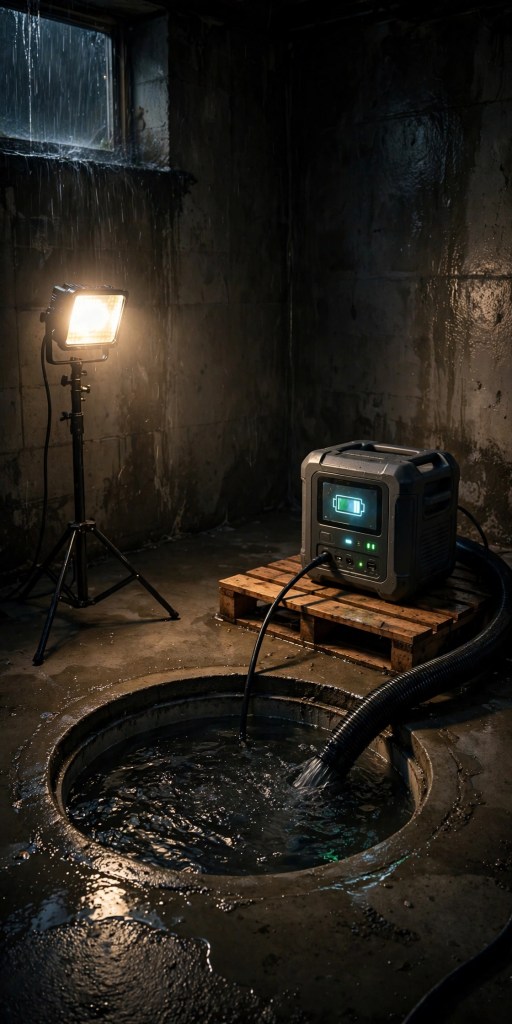
    A portable power station keeping a basement sump pump running during a storm outage
    Illustrative image — a generic station in a blackout scenario.

    Two numbers, not one

    A sump pump motor is an inductive load. When it starts, it draws far more current than it needs while running — a burst called inrush, starting, or surge current that lasts a fraction of a second. Your station has to clear two separate checks:

    1. The surge test. Can the inverter produce the pump’s starting watts? If not, the pump won’t start. Battery capacity is irrelevant at this point.
    2. The energy test. Does the station hold enough watt-hours to keep the pump cycling through the outage? This only matters after the surge test passes.

    For a typical 1/3 HP residential sump pump, manufacturer-published ranges look like this:

    Pump sizeRunning wattsStarting (surge) watts
    1/3 HP600–800 W1,200–2,400 W (EcoFlow’s blog cites up to 2,900 W)
    1/2 HP800–1,050 W2,400–4,100 W

    Sources: BLUETTI’s sump pump guide; EcoFlow’s sump pump guide. Your nameplate may differ — check it.

    Notice the gap. A 1/3 HP pump that runs on ~800 W can demand 2,000 W or more to start. That’s why matching the continuous rating alone fails.

    Why a 1,500W continuous station can still fail

    Take the Jackery Explorer 1000 v2: 1,500 W continuous output, 1,070 Wh — Manufacturer specification. Its surge rating is 3,000 W, so it clears a 2,000 W pump start with margin. But a 1,500 W continuous station whose surge rating is only 2,000 W would trip on a pump whose inrush reaches 2,400 W or 2,900 W.

    The rule: read the surge/peak figure, not the continuous figure, for the start test. Then read the continuous figure for the running test. Both have to clear, and for pumps the surge test fails first and most often.

    How to read surge ratings and “boost” modes honestly

    Not every big number on a spec sheet is a surge rating. Three major brands sell a “boost” feature with a different name, and all three work the same way: they lower the output voltage so resistive heating loads draw less current. That trick does nothing for a motor.

    • EcoFlow X-Boost (DELTA 3, DELTA 2 Max, DELTA 3 Max, DELTA Pro, DELTA Pro 3): a separate continuous-power allowance for high-demand devices. Use the plain surge figure for pump math, never the X-Boost figure.
    • BLUETTI Power Lifting (AC180): the record shows the AC180’s 2,700 W figure is explicitly “Power Lifting mode, for resistive heating devices.” That is not a motor surge rating — we don’t recommend it for sump pumps without a manufacturer clarification.
    • Anker SurgePad (SOLIX F2000): marketed 3,600 W SurgePad mode for “high-wattage inductive loads,” but the official spec figure is a 2,800 W surge. We use 2,800 W.

    Our policy: if the biggest number on the page is attached to a boost-mode name, it is not a surge rating. Count only the plain “surge,” “peak,” or “starting” watt figure.

    Worked example: a 1/3 HP pump against real stations

    The pump: ~800 W running, ~2,000 W+ starting (worst case near 2,900 W per EcoFlow’s published range). The bar: plain surge rating ≥ the pump’s starting watts, with margin; continuous ≥ 800 W.

    StationContinuousPlain surgeStarting test
    EcoFlow DELTA 31,800 W3,600 WPasses
    Jackery HomePower 1000 Plus v21,800 W3,600 W peakPasses
    Jackery Explorer 1000 v21,500 W3,000 WPasses
    Anker SOLIX C1000 Gen 22,000 W3,000 W peakPasses
    EcoFlow DELTA 21,800 W2,700 WPasses (thinner margin)
    BLUETTI AC1801,800 W2,700 W listed as Power Lifting (resistive only)Can’t verify for motors — excluded
    BLUETTI EB3A600 W1,200 WFails
    EcoFlow RIVER 3300 W600 WFails
    Jackery Explorer 500500 W1,000 WFails

    All specs above are Manufacturer specification, checked 2026-10-15; full source links are on each product record page.

    Then the energy test. Estimate: assume ~85% efficiency, so a 1,024 Wh station delivers ~870 Wh usable. Suppose the pump runs 20 minutes per hour during a heavy storm: 8 hours of pumping per day × 800 W = 6,400 Wh per day. The 1 kWh station covers roughly one hour of pumping.

    For a 1/2 HP pump whose starting watts reach 4,100 W (EcoFlow’s published range), 2 kWh-class options with plain surge ratings that clear it:

    StationCapacityContinuousPlain surgeWeightPrice
    EcoFlow DELTA 3 Max2,048 Wh2,400 W4,800 W44.8 lb$899
    EcoFlow DELTA 2 Max2,048 Wh2,400 W4,800 W50 lb$1,049
    Jackery Explorer 2000 v22,042 Wh2,200 W4,400 W39.4 lb$999
    Anker SOLIX C2000 Gen 22,048 Wh2,400 W4,000 W peak41.7 lb$999.99

    For 1/2 HP pumps, the DELTA 3 Max at $899 (check price) and DELTA 2 Max at $1,049 (check price) both publish 4,800 W surge ratings; the Jackery Explorer 2000 v2 publishes 4,400 W at $999 (check price). All Manufacturer specification, prices checked 2026-10-15.

    When the answer is “not a portable station”

    • The pump cycles nearly constantly and outages last days → a portable station buys hours; you need a larger system or a fuel-powered generator, refueled safely outdoors.
    • Your pump is 1/2 HP or larger and its starting watts exceed what portable inverters publish → check the surge rating against the upper end of your pump’s published range.
    • You want the pump wired to backup automatically → that’s transfer-switch or panel-interlock territory. Our boundary: anything that connects a backup source to your home’s wiring must be installed by a licensed electrician per the manufacturer’s instructions. We explain where the line is; we don’t cross it.

    The bottom line

    1. Check your pump’s nameplate for running watts; look up its starting watts by model.
    2. The station’s plain surge/peak rating must clear the starting watts with margin. Boost-mode numbers don’t count.
    3. Then check the energy math: (running watts × hours of pumping per day) ÷ 0.85. Estimate, with your duty cycle as the biggest variable.
    4. If the outage scenario is days of active pumping, price a dedicated pump-backup system or a generator + licensed-electrician installation instead of a bigger portable.

    Try the calculator next — enter your pump’s running watts and its starting watts in the surge field for motor loads, plus your best guess at duty cycle. Our product records carry the full spec sources, checked dates, and recall status for every station named above.


    Want one new backup-sizing lesson a week, plus verified price drops on the stations in this guide? Join the Outage Brief newsletter.

  • What UL 2743 does — and does not — mean

    “UL certified” is doing a lot of work on power station product pages — and most of it is theater. UL 2743 is the actual safety standard for portable power packs, but a logo on a listing tells you almost nothing unless you can verify it. This guide covers what the standard really covers, what people wrongly assume it means, how to verify a certification claim, and what our own review of 20 manufacturer product pages found: none of them stated a verifiable UL 2743 certification with a certificate number.

    Our picks for this guide

    EcoFlow DELTA 3 — A current-generation LiFePO4 unit from a major brand, sized for essentials.

    Jackery Explorer 1000 v2 — The all-rounder alternative in the same class.

    We may earn a commission if you purchase through links on this page, at no extra cost to you.

    What UL 2743 actually covers

    UL 2743 is the “Standard for Safety for Portable Power Packs,” published by UL Solutions (Underwriters Laboratories). It covers safety testing for portable and movable power packs: a box with one or more batteries inside, with inputs for charging and outputs — AC receptacles, USB ports, DC jacks, vehicle sockets — for running appliances where grid power isn’t available.

    The scope has real limits:

    • Capacity ceiling: 20 kWh. Anything bigger belongs under UL 9540, the energy-storage-system standard. All 20 power stations in our records sit under 20 kWh, so UL 2743 is the right standard for every unit we track. (The one exception, the EcoFlow DELTA Pro 3, carries a UL 9540 certification claim on its product page.)
    • Indoor/outdoor ratings matter. A certification doesn’t say “safe everywhere” — it says safe for the use the pack was evaluated for.
    • Not EV charging cabling, not phone power banks. EV recharging wiring is excluded; small phone power banks fall under UL 2056.
    • Not premise wiring. Power packs permanently connected to a building’s wiring are outside this standard — that’s UL 9540 territory, and why transfer switches and panel interlocks are electrician work.

    What a UL 2743 claim does NOT mean

    A logo with no certificate number is not verified. Per our editorial charter, any certification claim without a verifiable certificate or file number is labeled “not verified.” UL maintains the UL Product iQ database where listings can be looked up by company or file number; if the listing doesn’t give you a number to look up, you have nothing to verify.

    Combining certified components does not create a certified system. Per UL Solutions: “Simply combining individual, independently certified products in the field does not result in a certified (Listed) system.” The product itself — the whole assembly, in its enclosure — has to be evaluated.

    UL marks that aren’t UL 2743:

    • UL 1778 — covers uninterruptible power supplies. The Jackery Explorer 2000 v2 cites UL 1778 compliance for its UPS function only.
    • UL 94-V0 — a flammability rating for plastic materials, not a product safety listing. The Jackery Explorer 3000 Pro cites UL 94-V0 for its outer case.
    • UL 9540 — the energy-storage-system standard. The EcoFlow DELTA Pro 3 claims UL 9540 — a real certification to a different standard, not UL 2743.
    • Class B EMC — electromagnetic compatibility. The EcoFlow DELTA 3 Max page cites Class B EMC. That says nothing about battery safety.
    • FCC, RoHS, UN38.3, TÜV “testing” — none of these is equivalent to a UL 2743 product safety listing.

    How to verify a certification claim

    1. Find the file or certificate number. A genuine listing names something like “UL File E123456.”
    2. Look it up in UL Product iQ (UL Solutions’ public certification database). Confirm the specific model appears.
    3. Check the scope matches your use. Confirm the listing covers the model you buy and the intended use (indoor vs. outdoor rating).

    If step 1 fails — logo, no number — stop. That’s “not verified.”

    The honest finding: what we found on 20 manufacturer pages

    We looked for certification evidence on 20 manufacturer product pages and found none stated with a certificate number for UL 2743.

    To be precise: it doesn’t mean these products are unsafe, and it doesn’t mean they aren’t certified — it means we could not verify certification from the manufacturer pages we reviewed, and we’re not going to pretend otherwise. We re-check these pages regularly; if a manufacturer publishes a verifiable UL 2743 file number, the record gets updated. That’s the deal.

    Why this matters: the CPSC HALO 1000 recall

    In August 2024, the U.S. Consumer Product Safety Commission recalled about 5,740 HALO 1000 Portable Power Stations (model PS-1000), imported by ZAGG. The lithium-ion batteries could overheat, posing fire and burn hazards. Four fires were reported, and in June 2022, a 79-year-old Florida man died of smoke inhalation in a fire involving one of the units. CPSC’s remedy: stop using it immediately, cut the power cord, and contact the recall hotline for a free replacement.

    The point isn’t to scare you about power stations — millions of units run safely. The point is the decision lesson: battery products can fail, and independent third-party safety certification exists precisely for that reason. A certification mark you can verify is evidence; a logo with no certificate number is decoration. Buy the evidence.


    Next step: run your actual loads through the Outage Brief calculator to see estimated runtimes for the stations you’re comparing, with all assumptions shown.

    Stay current: we re-check certification evidence and prices on a schedule, and CPSC recalls trigger immediate record updates plus a newsletter note. Outage Brief newsletter.

  • This week’s verified power station deals: what’s actually on sale

    A “was $999, now $499” banner means nothing until you check the “was.” Every week we take the sale prices on portable power stations and test them: what was the actual list price, where did that number come from, and is the discount real, routine, or inflated. No coupon feed, no countdown timers — just a verdict per deal.

    First edition. This is the launch edition of this recurring weekly article. All prices checked 2026-10-15. All verdicts are preliminary: single data point — we have launch-day data only, so “genuine” below means the discount is real against a verified list price, not that it’s the lowest price ever.

    We may earn a commission if you purchase through links on this page, at no extra cost to you.

    The deals

    1. BLUETTI AC180 — $999 → $499 (50% off)

    • Was: $999 — per BLUETTI’s October 2026 press release (“originally $999”). Price checked 2026-10-15.
    • Now: $499 at bluettipower.com — Price checked 2026-10-15.
    • The numbers: 1,152Wh LiFePO4 at $499 works out to about $0.43/Wh — the strongest capacity-per-dollar on this week’s board.
    • Verdict: Genuine — preliminary: single data point. A real 50% cut against a list price BLUETTI itself stated in its own press release. (Product record)

    2. EcoFlow DELTA 2 — $699 → $349 (50% off)

    • Was: $699 — original price cited in deal reporting. Price checked 2026-10-15.
    • Now: $349 on Amazon during the October 2026 Prime Big Deal Days event — Price checked 2026-10-15 via dated deal reporting; Amazon was not directly reachable for verification. Check price — note: EcoFlow’s US direct store no longer lists the base DELTA 2. Price checked 2026-10-15.
    • The numbers: 1,024Wh LFP at $349 = about $0.34/Wh, on paper the cheapest dollar-per-watt-hour on the board.
    • Verdict: Genuine event deal — preliminary: single data point. Event pricing (recheck after the event ends); EcoFlow appears to be clearing the base DELTA 2 in favor of the DELTA 3. (Product record)

    3. Jackery Explorer 500 — $499 → $299 (40% off)

    • Was: $499 — corroborated (Jackery’s own page showed “$329.00/$499.00 $170 OFF”). Price checked 2026-10-15.
    • Now: $299 Amazon street price, per dated deal reporting. Price checked 2026-10-15. Check price — note: this URL currently redirects to the newer Jackery HomePower 1000 v2 page. Price checked 2026-10-15.
    • The catch: the Explorer 500 is effectively discontinued, and it’s the older NMC chemistry — 500 cycles to 80%+, roughly one-sixth the cycle life of current LiFePO4 models. See LiFePO4 batteries in plain English.
    • Verdict: Genuine clearance, not ongoing value — preliminary: single data point. (Product record)

    4. Anker SOLIX C1000 Gen 2 — $799 → $549.99 (31% off)

    • Was: $799 MSRP — per Anker’s launch announcement. Price checked 2026-10-15.
    • Now: $549.99 at ankersolix.com — Price checked 2026-10-15.
    • The numbers: 1,024Wh LiFePO4, 4,000 cycles to at least 80%, at $549.99 = about $0.54/Wh.
    • Verdict: Genuine below-MSRP pricing — preliminary: single data point. $250 under the launch MSRP with no inflated “was” price. (Product record)

    5. EcoFlow DELTA 3 Max — $1,199 → $899 (25% off)

    • Was: $1,199 — strikethrough price on EcoFlow’s US direct store. Price checked 2026-10-15. (Strongest list-price evidence in this edition: a manufacturer strikethrough on the manufacturer’s own page.)
    • Now: $899 at EcoFlow US DTC — Price checked 2026-10-15.
    • The numbers: 2,048Wh LFP at $899 = about $0.44/Wh. Note: the manufacturer page publishes no cycle-life count (unverified in our record).
    • Verdict: Genuine — preliminary: single data point. A real $300 cut against EcoFlow’s own strikethrough. (Product record)

    6. EcoFlow DELTA 3 — $699 → $629 (10% off)

    • Was: $699 — from a third-party retailer listing, not a manufacturer strikethrough. Price checked 2026-10-15.
    • Now: $629 at us.ecoflow.com — Price checked 2026-10-15.
    • The numbers: 1,024Wh LFP, 4,000 cycles to 80%+ at $629 = about $0.61/Wh.
    • Verdict: Routine — preliminary: single data point. A modest $70 trim; the “was” price comes from a third party rather than EcoFlow itself. (Product record)

    Also watching

    • Jackery Explorer 2000 v2 — $999 at jackery.com (checked 2026-10-15), but search crawls within the prior 48 hours showed a $899 sale price. On the watch list for next week. (Record)
    • Anker SOLIX F3800 — $2,199.99 at ankersolix.com, equal to its regular price. Not a deal; listed so the board stays honest about what’s not on sale. (Record)
    • BLUETTI EB3A — list $299 → $219 on bluettipower.com (checked 2026-10-15), but out of stock on BLUETTI US. Not listed as a deal until it’s actually buyable. (Record)

    How the check was done

    • Sources: manufacturer product pages first; dated third-party deal reporting only where noted (and flagged when the retailer page couldn’t be reached directly).
    • Timestamp: all prices checked 2026-10-15. Per our policy, entries go stale after 14 days — this edition expires October 29, 2026 unless re-verified.
    • Exclusions: refurbished units excluded unless stated. Bundle-only pricing is flagged, not listed. Records where the list price or current price is unverified were skipped entirely.
    • The “was” price test: manufacturer strikethrough and manufacturer-stated original prices rank highest; corroborated retailer history next; third-party original-price citations lowest.

    What changed vs last week

    First edition — no prior week. Next week’s edition adds a 7-day price history column once we have two data points.


    The deals email hook: this article updates weekly, but prices move daily. The Outage Brief newsletter sends the verified deal board every week — every price with its checked date, every verdict with its evidence. Free, no spam.

    Then size it right: a discount is only a deal if the unit fits your loads. Run your fridge, lights, and devices through the Outage Brief calculator before you buy.

  • What size power station keeps a refrigerator running?

    Short answer, then the math.

    An average full-size refrigerator needs about 1,500 watt-hours per day from a power station — so a 2,000Wh-class station covers a full 24 hours with margin. A 1,000Wh-class station covers roughly 8–12 hours: enough for an overnight outage or to bridge until the grid returns, but not a full day.

    Everything below shows how those numbers are derived, so you can substitute your own fridge’s numbers and reproduce the answer.

    Our picks for this guide

    BLUETTI Elite 200 V2 — Runs a fridge 32–36 hours in our sizing model, and the best value per kWh of the full-match group at $899.

    Jackery Explorer 2000 v2 — Also runs a fridge 31–35 hours, and at 39 lbs it’s the easiest of the big units to move.

    We may earn a commission if you purchase through links on this page, at no extra cost to you.

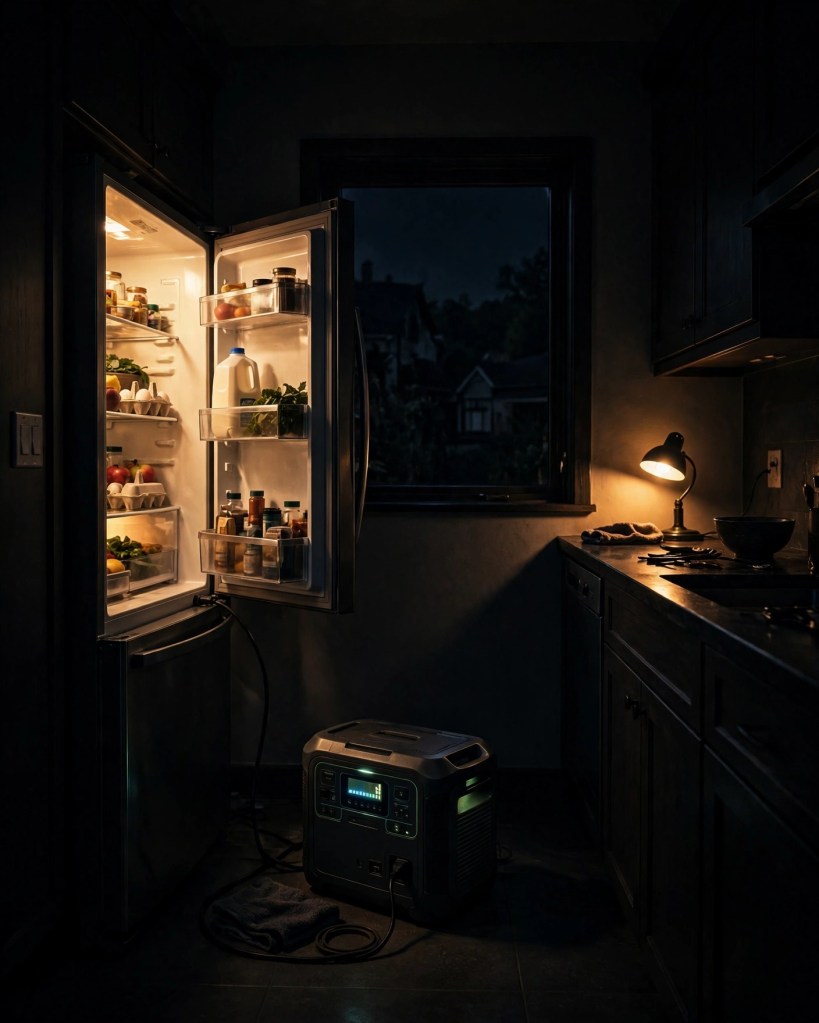
    A refrigerator kept cold by a portable power station during a home blackout
    Illustrative image — a generic station in a blackout scenario.

    Why the fridge sticker lies

    Your refrigerator’s door sticker shows a power rating — say, 150W. That number is misleading in three ways.

    Rated watts ≠ running watts. The sticker figure is a maximum or nominal rating. The compressor draws less while it runs.

    The compressor doesn’t run all the time. It cycles on and off. The fraction of time it’s running — the duty cycle — is typically around one-third (25–40%) for a household fridge in normal conditions.

    Startup surge. When the compressor kicks on, it briefly draws a spike of current — typically 5–8× its running watts for a fraction of a second. (Estimate — your manual may state it exactly.) A 150W-running fridge can briefly pull 750–1,200W. Your station’s surge rating must clear that spike.

    The best real number you have: your fridge’s EnergyGuide label lists estimated annual kWh. Divide by 365 for average daily use.

    The 3 numbers that matter

    #NumberWhat it decidesExample (this article)
    1Running wattsWhether the inverter can handle the load at all150W
    2Startup surgeWhether the station’s surge/peak rating clears the compressor’s kick-on spike~750–1,200W (Estimate)
    3Daily watt-hoursWhat battery capacity you need~1,260Wh/day (Estimate)

    The worked example

    Assume: 150W running, 35% duty cycle, 24 hours.

    Step 1 — daily energy the fridge consumes: 150W × 0.35 × 24h = 1,260Wh (Estimate)

    Step 2 — what the station must hold. We assume 85% inverter efficiency: 1,260Wh ÷ 0.85 ≈ 1,482Wh of station capacity (Estimate)

    Step 3 — keep a reserve. We plan with a 20% reserve: 1,482Wh × 1.2 ≈ 1,780Wh rated capacity for a full 24-hour day (Estimate)

    Round it: a 2,000Wh-class station covers a full day with margin.

    Why 1,000Wh usually isn’t enough for a full day

    A 1,000Wh station delivers roughly 850Wh after inverter loss (Estimate). Against our ~1,482Wh daily need, that’s about 57% of a day — 13–14 hours drained to empty, or ~11 hours keeping the 20% reserve (Estimates).

    Which capacity tier fits which scenario

    Surge ratings below are Manufacturer specifications, checked 2026-10-15 (per each product record). Estimated runtimes assume our example fridge (150W, 35% duty cycle, 85% efficiency, 20% reserve).

    ScenarioNeed (Estimate)TierExamples — price checked 2026-10-15
    ~8 hours (overnight / short outage)~590Wh1,000Wh classBLUETTI AC180 — 1,152Wh, $499.00 · EcoFlow DELTA 3 — 1,024Wh, $629.00 · Anker SOLIX C1000 Gen 2 — 1,024Wh, $549.99
    ~24 hours (a full day)~1,780Wh2,000Wh classBLUETTI AC200L — 2,048Wh, $899 · BLUETTI Elite 200 V2 — 2,073.6Wh, $899 · EcoFlow DELTA 3 Max — 2,048Wh, $899
    ~48 hours (multi-day outage)~3,560Wh3,600Wh classEcoFlow DELTA Pro — 3,600Wh, $1,799

    A closer look at each tier’s examples:

    1,000Wh class — the overnight tier.

    • BLUETTI AC180 — 1,152Wh, 1,800W continuous output, 2,700W surge. 35.3 lbs, 5-year warranty (Manufacturer specification). Check price
    • EcoFlow DELTA 3 — 1,024Wh, 1,800W continuous, 3,600W surge. Recharges in about 56 minutes on AC, expandable to 5kWh, 5-year warranty (Manufacturer specification). Check price
    • Anker SOLIX C1000 Gen 2 — 1,024Wh, 2,000W continuous, 3,000W peak. 24.9 lbs — the lightest of the three — with ~49-minute AC recharging (Manufacturer specification). Check price

    2,000Wh class — the full-day tier.

    • BLUETTI AC200L — 2,048Wh, 2,400W continuous. 62.4 lbs (Manufacturer specification). Check price
    • BLUETTI Elite 200 V2 — 2,073.6Wh, 2,600W continuous, 3,900W surge. 53.4 lbs (Manufacturer specification). Check price
    • EcoFlow DELTA 3 Max — 2,048Wh, 2,400W continuous, 4,800W surge, 0–80% recharge in about 68 minutes (Manufacturer specification). Check price

    3,600Wh class — the multi-day tier.

    • EcoFlow DELTA Pro — 3,600Wh, 3,600W continuous, 7,200W surge. About 99 lbs; expandable with extra batteries for longer outages (Manufacturer specification). Check price

    Every one of these clears our example fridge’s ~750–1,200W startup spike on continuous output alone. Surge is rarely the binding constraint on a fridge — capacity is.

    What changes the math

    Duty cycle. The 35% in our example is a middle estimate. A fridge in a hot garage opened constantly can run a 50–60% duty cycle; a fridge in a cool basement barely opened can drop to 25%.

    Second loads. A 2,000Wh station covering your fridge for 24 hours has roughly 200Wh of headroom left. Add a 65W laptop charging for three hours and you’ve spent most of it.

    When in doubt, use your EnergyGuide number (annual kWh ÷ 365) instead of our 150W/35% example.

    Substitute your own fridge

    1. Read your EnergyGuide label: annual kWh ÷ 365 = daily Wh.
    2. Divide by 0.85 for inverter loss.
    3. Multiply by 1.2 for a 20% reserve.
    4. Pick a station with at least that rated capacity, then confirm its continuous output clears your fridge’s running watts.

    Example: a 480 kWh/year fridge → 1,315Wh/day ÷ 0.85 × 1.2 ≈ 1,857Wh → a 2,000Wh-class station (Estimates).

    Your next step

    Run your exact fridge through the Outage Brief calculator — the fridge preset pre-loads typical running watts and duty cycle. It applies the same inverter-efficiency and reserve math above to every station in our database.

    And if you want one short email a week with deal prices and sizing walkthroughs like this one, join the Outage Brief newsletter.