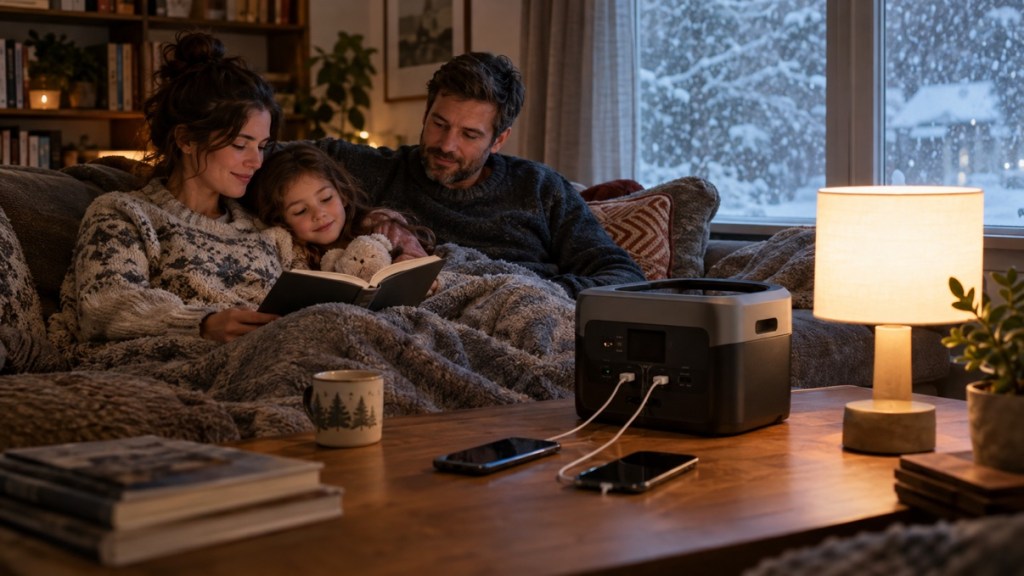
A winter outage is a different problem from a summer one. The stakes feel higher — cold house, dark early evenings, a fridge full of food — but the battery math is mostly the same, and one common instinct is wrong: a portable power station is not a furnace. This guide separates what a station can honestly do in a winter storm from what it can’t, so you buy (and plan) for the right job.
We may earn a commission if you purchase through links on this page, at no extra cost to you.
All runtimes below are Estimates using the same planning math as our sizing guide: usable energy ≈ rated capacity × 85% inverter efficiency, with a reserve margin for the loads that matter most. Specs are Manufacturer specifications checked 2026-10-15 against our product records. We have not hands-on tested these units. Prices are manufacturer-store prices last checked Oct 15–26, 2026; treat them as the last verified figure, not a live price.
Short answer
A portable power station is not a furnace: heat one room and warm people, not space. A 2,000Wh-class station covers a fridge for roughly a day with headroom for lights and phones, and for multi-day storms capacity and solar refill matter most. Picks are based on manufacturer specs and the site’s sizing math.
- EcoFlow DELTA 3 Max — Why it fits: best overall for a winter outage; the 2,000Wh class is the winter sweet spot.
Est. runtime (calculated estimate): fridge 31–35 hrs.
Tradeoff: the base model is not expandable, and solar input is limited to 500W.
Check price - BLUETTI AC180 — Why it fits: best budget; half the price of the overall pick.
Est. runtime (calculated estimate): fridge 18–20 hrs.
Tradeoff: no expansion battery option.
Check price - EcoFlow DELTA Pro 3 — Why it fits: best for multi-day winter storms, with capacity and solar refill to match.
Est. runtime (calculated estimate): fridge 62–70 hrs.
Tradeoff: at 113.5 lbs it is very heavy to move.
Check price
The one winter mistake to avoid: heating the whole house with a battery
A typical portable space heater draws about 1,500W while it runs. Run that number through the math:
- A 2,048Wh station holds about 1,740Wh of usable energy at 85% efficiency (Estimate).
- 1,740Wh ÷ 1,500W ≈ 1.2 hours of continuous heating (Estimate).
- Even if the heater cycles on half the time, that’s roughly 2–2.5 hours (Estimate) — not a night, not a day.
The honest winter strategy is the opposite: heat one room, warm people, not space. Close doors, draft-stop the room you’re sleeping in, layer clothing and blankets, and spend battery on low-wattage warmth — a heated blanket or pad draws a small fraction of a space heater’s power (check the label on yours; divide its watts into the usable-energy figure above to get its runtime). A station that can’t heat a house for a night can keep phones, lights, a router, and a low-wattage blanket going for a day or more. That trade is the whole plan.
One more boundary: a furnace, boiler, or other hardwired heating system can’t be plugged into a portable station at all. Anything that connects backup power to your home’s wiring — transfer switches, panel interlocks — belongs to a licensed electrician and the manufacturer’s instructions. See the transfer-switch boundary guide. We don’t give installation advice, and this guide doesn’t either.
What winter actually threatens, load by load
Food. Cold weather doesn’t save your fridge the way people assume — the fridge still cycles, and every door-opening to check on food costs energy. Plan on the same figure as the rest of the year: a typical full-size fridge needs about 1,260Wh per day (150W running × 24 hours × ~35% duty cycle; see what size power station for a refrigerator). A 2,000Wh-class station covers that for roughly a day with room for lights and phones; a 1,000Wh-class station falls short of a full day. If the outage stretches past a day, a cold porch or garage is not a food-safety plan — perishable food still needs to stay at refrigerator temperature, and a thermometer, not the weather, is the check.
Water and pumps. Winter storms bring the wet half of the problem: a sump pump working through melt and rain, and, for well-water homes, no water at all without power. A sump pump’s startup surge is the trap — motor loads spike far above their running watts. Our sump pump surge guide explains how to check a pump against a station’s surge rating before you count on it. If your pump is hardwired rather than plug-in, the electrician boundary above applies.
Light and connection. Winter nights are long, which makes this the easiest win: LED lights, a router, and phone charging together draw very little. A phone holds roughly 15Wh per full charge (from our phones guide); a household’s phones, router, and lights for a day fit comfortably in the headroom left over after the fridge on a 2,000Wh station. This is also the load most worth protecting, because weather updates, outage maps, and a working phone are how you decide whether to stay or go.
When to leave. No station changes the leave-or-stay call. If the house is getting dangerously cold, if anyone depends on powered medical equipment, or if local authorities advise evacuation, go — a battery is a comfort bridge, not a substitute for heat, water, or medical care. Decide that threshold before the storm, not at 2 a.m. in a cold house.
Winter-specific station care
- Charge before the storm, not during it. A station at 100% before the wind arrives is worth more than any sale price during it. Top up when a storm is forecast, and re-check the charge the morning it arrives.
- Keep the station indoors at room temperature. Batteries perform worse cold, and charging a freezing-cold battery is hard on it. Store and charge yours inside, and check your model’s manual for its rated temperature range rather than assuming one.
- Don’t count on solar until the snow is off. Panels under snow produce little, and short winter days already limit harvest. If solar is part of a multi-day plan, plan to clear panels gently per the manufacturer’s instructions once the storm passes — and size the battery as if solar contributes nothing on day one.
- Recharge whenever the grid flickers back. Even an hour of grid power matters: the DELTA 3 Max below recharges 0–80% in about 68 minutes (Manufacturer specification). A station that tops up during every flicker lasts far longer than one that waits for a full restoration.
- Test it before you need it. Once a season, run your actual loads — fridge, lights, phones — off the station for an hour and watch the battery percentage. That one test tells you more than any spec sheet, and it catches a dead cable or a forgotten setting while stores are still open.
The picks, by winter job
Best overall for a winter outage — EcoFlow DELTA 3 Max
- Capacity: 2,048Wh · Est. fridge runtime: 31–35 hrs · Price: $899 (checked Oct 26, 2026)
- 2,400W continuous / 4,800W surge (Manufacturer specification); 44.8 lbs
The 2,000Wh class is the winter sweet spot: it carries the fridge through a full day with headroom for lights, phones, and low-wattage warmth, and it recharges fast during grid flickers. Its limitation is the same as every fixed-size station: no expansion port, so a multi-day outage needs solar or a second station, not a bigger battery added later.
Best budget — BLUETTI AC180
- Capacity: 1,152Wh · Est. fridge runtime: 18–20 hrs · Price: $499 (checked Oct 26, 2026)
- 1,800W continuous / 2,700W surge, Power Lifting mode for resistive heating devices (Manufacturer specification); 35.3 lbs
Half the price, and honest about its limit: it covers the fridge for most of a day but not a full 24 hours, so it’s the pick for outages that usually end the same day, or as a second station for lights and phones while a bigger unit runs the fridge. At 35.3 lbs it’s also the easiest here to move to the room you’re actually sleeping in.
Best for multi-day winter storms — EcoFlow DELTA Pro 3
- Capacity: 4,096Wh · Est. fridge runtime: 62–70 hrs · Price: $2,799 (checked Oct 15, 2026)
- 4,000W continuous / 8,000W surge (Manufacturer specification); 113.5 lbs; expandable to 12,288Wh; up to 2,600W solar input (Manufacturer specification)
When the forecast says days, not hours, capacity and solar refill matter more than anything else. The DELTA Pro 3 carries the example fridge for roughly two and a half days on its own, and its 2,600W solar input — the most in this lineup — is what makes a sunny post-storm day a real refill rather than a trickle. Its limitation is weight and price: 113.5 lbs is a park-it-before-the-storm unit, and its 240V output is capability a fridge-only plan never uses. Compare it with the Anker SOLIX F3800 (3,840Wh, 6,000W, $2,199.99, checked Oct 15, 2026) if 240V appliances are part of your plan.
The winter checklist (before the storm)
- Station charged to 100%, indoors, with its cables where you can find them in the dark.
- Fridge and freezer full and cold (a full fridge holds temperature better than an empty one); thermometer inside.
- One warm room picked, doors and drafts dealt with, blankets and low-wattage warmth in that room.
- Phones, power banks, and a radio charged; outage-map and utility numbers saved, not just bookmarked.
- Sump pump checked against your station’s surge rating — or the electrician’s number saved if it’s hardwired.
- Leave-or-stay threshold agreed with the household before the storm arrives.
Your next step
Run your own winter load list — fridge, lights, phones, and whatever low-wattage warmth you actually own — through the Outage Brief sizing guide. It applies the same duty-cycle, efficiency, and reserve math as this guide to all 20 stations in our database, so you’ll see whether your plan survives a day or a weekend before the storm tests it for you.

